Content for TS 23.434 Word version: 19.2.0


0…
4…
5
6…
6.4…
6.5…
6.5.3…
7…
8…
8.2.2…
9…
9.3…
9.3.2.21…
9.3.3…
9.3.6…
9.3.11…
9.3.13…
9.3.14…
9.4…
9.4.6…
9.5…
10…
10.3…
10.3.2.22…
10.3.3…
10.3.7…
10.3.10…
10.4…
11…
11.3…
11.3.3…
11.4…
12…
12.3…
13…
14…
14.2.2.2…
14.3…
14.3.2.20…
14.3.2.40…
14.3.3…
14.3.3.3…
14.3.4…
14.3.4.6
14.3.4.7…
14.3.4A…
14.3.4A.3…
14.3.4A.4…
14.3.4A.6…
14.3.4A.8…
14.3.4A.9…
14.3.4A.10…
14.3.5…
14.3.6…
14.3.9…
14.3.12…
14.4…
15…
16…
17…
18…
A
B…
12 Identity management
12.1 General
12.2 Functional model for identity management
12.2.1 General
12.2.2 On-network functional model description
12.2.3 Off-network functional model description
12.2.4 Functional entities description
12.2.4.1 General
12.2.4.2 Identity management client
12.2.4.3 Identity management server
12.2.5 Reference points description
12.2.5.1 General
12.2.5.2 IM-UU
12.2.5.3 IM-PC5
12.2.5.4 IM-C
12.2.5.5 IM-S
12.2.5.6 IM-E
...
...
12 Identity management p. 147
12.1 General p. 147
The identity management is a SEAL service that offers the identity management related capabilities to one or more vertical applications.
12.2 Functional model for identity management p. 147
12.2.1 General p. 147
The functional model for the identity management is based on the generic functional model specified in clause 6. It is organized into functional entities to describe a functional architecture which addresses the support for identity management aspects for vertical applications. The on-network and off-network functional model is specified in this clause.
12.2.2 On-network functional model description p. 148
Figure 12.2.2-1 illustrates the generic on-network functional model for identity management.
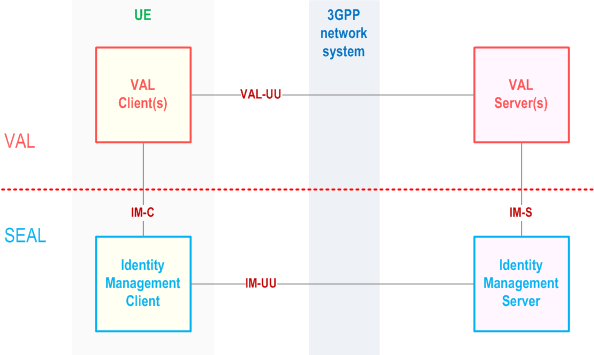
The identity management client communicates with the identity management server over the IM-UU reference point. The identity management client provides the support for identity management functions to the VAL client(s) over IM-C reference point. The VAL server(s) communicate with the identity management server over the IM-S reference point.
12.2.3 Off-network functional model description p. 148
Figure 12.2.3-1 illustrates the off-network functional model for identity management.
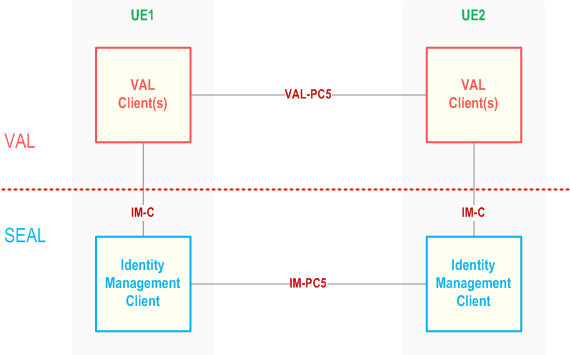
The identity management client of the UE1 communicates with the identity management client of the UE2 over the IM-PC5 reference point.
12.2.4 Functional entities description p. 148
12.2.4.1 General p. 148
The functional entities for identity management SEAL service are described in the following subclauses.
12.2.4.2 Identity management client p. 149
The identity management client functional entity acts as the application client for vertical applications layer user identity related transactions. The identity management client interacts with the identity management server. The identity management client also supports interactions with the corresponding identity management client between the two UEs.
12.2.4.3 Identity management server p. 149
The identity management server is a functional entity that authenticates the vertical application layer user identity. The authentication is performed by verifying the credentials provided by the vertical applications' user. The identity management server acts as CAPIF's API exposing function as specified in TS 23.222. The identity management server also supports interactions with the corresponding identity management server in distributed SEAL deployments.
12.2.5 Reference points description p. 149
12.2.5.1 General p. 149
The reference points for the functional model for identity management are described in the following subclauses.
12.2.5.2 IM-UU p. 149
The interactions related to identity management functions between the identity management client and the identity management server are supported by IM-UU reference point. This reference point utilizes Uu reference point as described in TS 23.401 and TS 23.501.
12.2.5.3 IM-PC5 p. 149
The interactions related to identity management functions between the identity management clients located in different VAL UEs are supported by IM-PC5 reference point. This reference point utilizes PC5 reference point as described in TS 23.303.
12.2.5.4 IM-C p. 149
The interactions related to identity management functions between the VAL client(s) and the identity management client within a VAL UE are supported by IM-C reference point.
12.2.5.5 IM-S p. 149
The interactions related to identity management functions between the VAL server(s) and the identity management server are supported by IM-S reference point. This reference point is an instance of CAPIF-2 reference point as specified in TS 23.222.
12.2.5.6 IM-E p. 149
The interactions related to identity management functions between the identity management servers in a distributed deployment are supported by IM-E reference point.


