This clause specifies procedures for NF in the LCS system to interact with NWDAF for data analytics. General framework for NF in the LCS system to interact with NWDAF for data analytics refers to the clauses 6.1.1 and 6.1.2 of TS 23.288.
Clause 6.21.1 describes the procedures of Location Accuracy Analytics retrieved by LMF.
Clause 6.21.2 describes the procedures of UE Mobility Analytics retrieved by AMF.
The procedure in Figure 6.21-1 can be used by a 5GC NF involved in 5GC location services to get optional assistance from NWDAF as shown below.
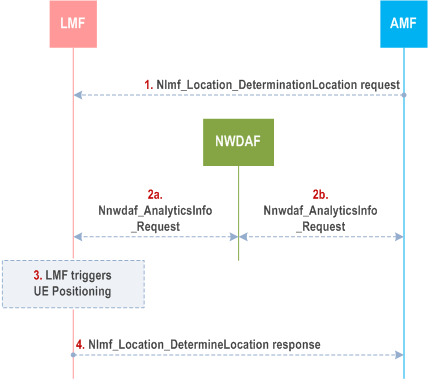
LMF may request Location Accuracy Analytics from NWDAF to retrieve the location accuracy.
The procedure to request Location accuracy analytics by LMF is referred to clause 6.17.4 of TS 23.288. In Figure 6.17.4-1 of TS 23.288 the Analytics consumer is replaced by LMF. Pre-condition of the procedure is NWDAF has a trained supervised ML model for deriving Location Accuracy Analytics.
AMF may request assistance for UE location verification for NR satellite access as described in clause 6.10.1 by requesting or subscribing to UE mobility analytics from NWDAF. With NWDAF-based UE location statistics and predictions and UE location estimated by LMF, AMF can further assist UE location verification for NR satellite access.
This clause describes the procedure for data collection by the LMF for input data to train or monitor the performance of the ML model for LMF-based AI/ML positioning.
The LMF determines that data collection from the NG-RAN is required e.g. to train an ML Model for UE positioning for a number of UEs or to monitor the ML Model performance. The LMF may also initiate the data collection upon the request of an NWDAF containing MTLF as described in step 3 in Figure 6.22.4-1.
The LMF may know the SUPIs of the UEs for which to collect location measurement data from the NG-RAN, e.g. when training an ML model using the PRU(s) associated to this LMF. The LMF may optionally invoke an Nnrf_NFDiscovery_Request to an NRF to discover other PRU serving LMF(s) which has associated PRUs in the area of interest and send an Nlmf_DataExposure_Subscribe request to the selected PRU serving LMFs to collect the PRU locations and the measurement data from the NG-RAN for the PRUs; the following steps may be skipped in this case.
If the LMF does not know the SUPIs of the UEs for which to collect location measurement data from the NG-RAN, the LMF tries to get the list of SUPIs from the AMF. Before that the LMF discovers the AMF(s) that serves the area of interest via the NRF using Nnrf_NFDiscovery_Request.
The LMF subscribes to the list of SUPIs in an area of interest from the AMF(s) using Namf_EventExposure_Subscribe request (Target of Event Reporting = "any UE", Event ID = "UEs in/out area of interest", indication of requesting UE Positioning Capability).
The AMF sends Namf_EventExposure_Subscribe response or Namf_EventExposure_Notify (list of SUPIs in the area of interest). If UE Positioning Capability is also requested, AMF includes UE Positioning Capability and optionally UE User Plane Positioning Capabilities, if available, for each UE in the response message sent to LMF.
For each SUPI in the area of interest, the following steps are performed.
Depending on local regulation and operator policies, the LMF may need to check whether the SUPI provided user consent for data collection for a purpose with UDM using Nudm_SDM_Get including subscription data type set to "User consent" for this SUPI then step 5 is performed, otherwise step 6 follows.
The LMF may further determine the UEs from the list of SUPIs that are received from AMF in step 3 for data collection based on e.g. UE Positioning Capability, UE User Plane Positioning Capabilities, the PRU information available in the LMF and operator's policy. The LMF may retrieve UE Positioning Capability and optionally UE User Plane Positioning Capabilities if not received in step 3.
The LMF subscribes to UDM to notifications of changes on subscription data type "User consent" for this SUPI using Nudm_SDM_Subscribe. If user consent for purpose "model training" is granted, then step 6 follows, otherwise no data is collected for this SUPI, i.e. the following steps are not performed.
To obtain ground truth data, the LMF collects location information as specified in TS 37.355 from the UE and/or determines UE location by itself, using the procedures as described in clause 6.11.1, clause 6.11.4, clause 6.17 or step 15-17 of clause 6.3.1, where the UE can be a PRU or non-PRU UE. The LMF then decides whether to use the UE location information as the ground truth data taking into account the quality of UE location information.
The UE may reject the data collection request from the LMF (e.g. considering UE status, user's input). If the UE accepts data collection request, the UE may cancel the data collection later as defined in clause 6.3.4.
The LMF may determine that the UE is no longer in the area of interest, based on the AMF notification using Namf_EventExposure service, then the LMF performs step 10 and step 11, the LMF may unsubscribe to be notified on user consent updates if the UE is not in the area of interest any longer.
The UDM may notify the LMF on changes of user consent at any time after step 5 using Nudm_SDM_Notification including SUPI and Subscription data type set to "User consent". If user consent is no longer granted for a user for which data has been collected the LMF performs step 10 and step 11. The LMF may unsubscribe to be notified of user consent updates from UDM for each SUPI for which data consent has been revoked, using Nudm_SDM_Unsubscribe including SUPI and Subscription data type set to "User consent".
The LMF may stop any retrieval of ground truth data for the UE as described in clause 5 of TS 37.355.
The measurements from NG-RAN as described in TS 38.305 and ground truth data from UE as described in TS 37.355 are used for ML model training. The UE location is derived from the measurements data by using LMF-based AI/ML Positioning. The derived UE location and ground truth data are used for ML model performance monitoring.
The LMF may initiate data collection for multiple UEs simultaneously, as such steps 6 and 7 may occur in parallel for a number of SUPIs as determined by the LMF.
The NWDAF containing MTLF may subscribe to input data (i.e. location measurement data and ground truth UE location) from LMF for ML model training or ML model performance monitoring for LMF-based AI/ML Positioning.
NWDAF containing MTLF determines to train a ML model for LMF-based AI/ML Positioning based on the request from LMF or internal trigger, or the NWDAF containing MTLF determines to perform ML model performance monitoring for LMF-based AI/ML Positioning.
The NWDAF invokes an Nnrf_NFDiscovery_Request service operation to an NRF to discover an LMF, the service operation includes an AoI and the Nlmf_DataExposure service as discovery parameters. If the NWDAF wants to collect the input data of PRUs, the NWDAF may also include a PRU existence indication for discovering the LMF(s) associated with PRUs (the PRU association procedures are defined in clause 6.17). The NRF selects one or more LMFs based on the AoI, the Nlmf_DataExposure service, and the PRU existence indication (if available), and sends an Nnrf_NFDiscovery_Request Response which includes the profiles of the selected LMFs to the NWDAF.
The NWDAF subscribes to or cancels subscription to input data from LMF by invoking Nlmf_DataExposure_Subscribe / Nlmf_DataExposure_UnSubscribe service operation. The NWDAF includes an AoI and a notification target address to request the input data from LMF. The NWDAF may also include requested number of data samples, time window of data samples, quality threshold, ML model identifier (for ML model performance monitoring), data source type (i.e. NG-RAN measurement). The quality threshold indicates to the LMF to provide ground truth data only when the ground truth data meets the quality threshold. The detailed parameters are defined in clause 8.3.4.
For ML model training and ML model performance monitoring, the LMF performs the procedure for data collection in clause 6.22.3 to collect data from PRUs/UEs and/or the NG-RAN. For ML model performance monitoring, the LMF may also calculate the location estimation of PRU(s)/UE(s) using the collected data and the ML model identified by the ML model identifier if received in step 3.
The LMF sends the collected data samples (i.e. location measurement data from the NG-RAN, the corresponding ground truth data (i.e. location of PRUs or UEs) and the quality indicator of the ground truth data) to the NWDAF by invoking Nlmf_DataExposure_Notify service operation. The LMF may send a cause code to the NWDAF when the requested number of data samples cannot be met. The LMF may also send the location estimation of PRU(s)/UE(s) calculated in step 4 (if applicable). Then the NWDAF trains the ML model or performs ML model performance monitoring based on the data samples received from the LMF.
The LMF discovers an NWDAF that can provide trained ML model(s) for LMF-based AI/ML positioning, by invoking the Nnrf_NFdiscovery_Request service operation including parameters as specified in clause 5.18.
The LMF receives from the NRF a list of candidates NWDAF instances that match the attributes provided in the Nnrf_NFDiscovery_Request, as specified in clause 5.2.7.3 of TS 23.502.
The LMF selects a NWDAF out of the list of candidates NWDAF instances, and then requests trained ML Model(s) using Nnwdaf_MLModelInfo_Request or Nnwdaf_MLModelProvision_Subscribe including parameters as described in clause 5.18.
The NWDAF provides one or more trained ML Models for LMF-based AI/ML positioning to the LMF including parameters as described in clause 5.18. If the LMF receives ADRF (Set) ID in the ML Model Information, the LMF may retrieve the ML Model from ADRF as described in clause 6.2B.7 of TS 23.288.
If the LMF subscribes to receive trained ML Model(s) for LMF-based AI/ML positioning from the NWDAF in step 4, the NWDAF provides information of either a new trained or the re-trained ML model including parameters as described in clause 5.18 to the LMF by invoking Nnwdaf_MLModelProvision_Notify service operation .
Based on the information of either a new trained or the re-trained ML model provided in step 6 by the NWDAF, the LMF may update the trained ML Model(s) accordingly.
This clause describes the procedure for data collection by the NG-RAN for input data to train or monitor the performance of the ML model for NG-RAN node assisted positioning with gNB-sided model.
Figure 6.23.2-1 shows a procedure of data collection for UEs under positioning by the NG-RAN, in order to train or monitor the performance of the gNB-sided ML model for NG-RAN node assisted positioning.
The procedure in Figure 6.11.2-1 can be used for data collection by the NG RAN for input data to support NG-RAN node assisted positioning with gNB-side model.
The steps 1-6 of network assisted positioning procedure are used as defined in clause 6.11.2 and the information to indicate that data collection is needed for the UE being positioned is included by the NG-RAN node in the Network Positioning message in steps 5-6 as defined in NRPPa signalling in TS 38.455.
Before the LMF provides the data for the UE being positioned to the NG-RAN, the LMF performs the user consent check by interaction with UDM as defined in step 4 of clause 6.22.3. If user consent is not granted, LMF sends to the NG-RAN an appropriate indication as defined in TS 38.455 and the following steps are skipped.
The LMF determines the data requested by NG-RAN based on the ground truth data of the UE. The LMF sends the requested data via the AMF to the NG-RAN node in a Network Positioning message as defined in TS 38.455. If the LMF is unable to provide the positioning information, LMF sends to the NG-RAN an appropriate indication as defined in TS 38.455.