Content for TS 23.222 Word version: 19.2.0


0…
4…
5…
6…
6.3…
6.4…
7…
8…
8.5…
8.8…
8.9…
8.13…
8.17…
8.21…
8.25…
8.26…
8.28…
8.30…
9…
10…
10.4…
10.7…
11…
A
B…
B.2…
B.3…
C…
D…
8.25 Support for CAPIF interconnection
8.25.1 General
8.25.2 Information flows
8.25.2.1 Interconnection API publish request
8.25.2.2 Interconnection API publish response
8.25.2.3 Interconnection service API discover request
8.25.2.4 Interconnection service API discover response
8.25.2.5 Interconnection API unpublish request
8.25.2.6 Interconnection API unpublish response
8.25.2.7 Interconnection get service API request
8.25.2.8 Interconnection get service API response
8.25.2.9 Interconnection update service API request
8.25.2.10 Interconnection update service API response
8.25.3 Procedure
8.25.3.1 Service API publish for CAPIF interconnection
8.25.3.2 Service API discovery involving multiple CCFs
8.25.3.3 Service API discovery for CAPIF interconnection
8.25.3.4 Service API unpublish for CAPIF interconnection
8.25.3.5 Retrieve service APIs for CAPIF interconnection
8.25.3.6 Update service APIs for CAPIF interconnection
...
...
8.25 Support for CAPIF interconnection |R16| p. 80
8.25.1 General p. 80
The procedures in this subclause corresponds to the architectural requirements on CAPIF interconnection.
8.25.2 Information flows p. 80
8.25.2.1 Interconnection API publish request p. 80
Table 8.25.2.1-1 describes the information flow interconnection API publish request from CAPIF core function to CAPIF core function.
| Information element | Status | Description |
|---|---|---|
| CCF information | M | The information of the CAPIF core function which publishes APIs, may include identity, authentication and authorization information |
| Service API information | O (see NOTE 1) | The service API information includes the service API name, API provider name (optional), List of public IP ranges of UEs (optional and applicable only on CAPIF-6 interface), service API category, service API status (e.g. active, inactive), communication type, description, Serving Area Information (optional), AEF location (optional), interface details (e.g. IP address, port number, URI), protocols, version numbers, data format, Service KPIs (optional), and Network Slice Info (optional). |
| Service API category | O (see NOTE 1) | The category of the service APIs to be published, (e.g. V2X, IoT) |
| Shareable information | O (see NOTE 2) | Indicates whether the service API information or the service API category can be published to other CCFs. And if sharing, a list of CAPIF provider domain information where the service API information or the service API category can be published is contained. |
|
NOTE 1:
At least one of the Service API information or Service API category shall be present.
NOTE 2:
If the shareable information is not present, the service API is not allowed to be shared. There is one and only one CAPIF provider domain information sharable via the CAPIF-6e interface.
|
||
8.25.2.2 Interconnection API publish response p. 81
Table 8.25.2.2-1 describes the information flow interconnection API publish response from CAPIF core function to CAPIF core function.
| Information element | Status | Description |
|---|---|---|
| Result | M | Indicates the success or failure of publishing the service API information |
| Service API published information reference | O (see NOTE) | The information which can be used for referencing the information (set) about the published service API by the CCF which publishes service APIs |
|
NOTE:
This information element is included when the Result indicates success.
|
||
8.25.2.3 Interconnection service API discover request p. 81
Table 8.25.2.3-1 describes the information flow interconnection service API discover request from one CAPIF core function to another CAPIF core function.
| Information element | Status | Description |
|---|---|---|
| CAPIF core function identity information | M | Identity information of the CAPIF core function discovering service APIs |
| Query information | M | Criteria for discovering matching service APIs or CAPIF core function (e.g. service API category, Serving Area Information (optional), UE IP address (optional), preferred AEF location (optional), required API provider name (optional), interfaces, protocols, service API category, Service KPIs (optional)), and Network Slice Info (optional) (see NOTE). |
|
NOTE:
It should be possible to discover all the service APIs.
|
||
8.25.2.4 Interconnection service API discover response p. 82
Table 8.25.2.4-1 describes the information flow interconnection service API discover response from one CAPIF core function to another CAPIF core function.
| Information element | Status | Description |
|---|---|---|
| Result | M | Indicates the success or failure of the discovery of the service API information |
| Service API information | O (see NOTE) | List of service APIs corresponding to the request, including service API information as specified in Table 8.25.2.1-1. |
| CAPIF core function identity information | O (see NOTE) | Indicates the CAPIF core function matching the service API category in the query criteria |
|
NOTE:
The service API information or the CAPIF core function identity information or both shall be present, if the Result information element indicates that the interconnection service API discover operation is successful. Otherwise, both shall not be present.
|
||
8.25.2.5 Interconnection API unpublish request |R19| p. 82
Table 8.25.2.5-1 describes the information flow interconnection API unpublish request from a CAPIF core function to another CAPIF core function.
| Information element | Status | Description |
|---|---|---|
| CCF information | M | The information of the CAPIF core function which unpublishes service APIs, may include identity, authentication and authorization information |
| Service API published information reference
(see NOTE) | M | The information which can be used for referencing the information (set) about the published service API by the CCF which publishes service APIs. |
|
NOTE:
Obtained during the interconnection API publish procedure in clause 8.25.3.1.
|
||
8.25.2.6 Interconnection API unpublish response |R19| p. 82
Table 8.25.2.6-1 describes the information flow interconnection API unpublish response from a CAPIF core function to another CAPIF core function.
| Information element | Status | Description |
|---|---|---|
| Result | M | Indicates the success or failure of unpublishing the service API information |
8.25.2.7 Interconnection get service API request |R19| p. 83
Table 8.25.2.7-1 describes the information flow interconnection get service API request from a CAPIF core function to another CAPIF core function.
| Information element | Status | Description |
|---|---|---|
| CCF information | M | The information of the CAPIF core function that wants to retrieve service APIs information. It may include identity, authentication and authorization information |
| Service API published information reference
(see NOTE) | M | The information which can be used for referencing the information (set) about the published service API by the CCF which publishes service APIs |
|
NOTE:
Obtained during the interconnection API publish procedure in clause 8.25.3.1.
|
||
8.25.2.8 Interconnection get service API response |R19| p. 83
Table 8.25.2.8-1 describes the information flow interconnection get service API response from a CAPIF core function to another CAPIF core function.
| Information element | Status | Description |
|---|---|---|
| Result | M | Indicates the success or failure of unpublishing the service API information |
| Service API information | O
(see NOTE) | The service API information includes the service API name, service API type, communication type, description, Serving Area Information (optional), interface details (e.g. IP address, port number, URI), protocols, version numbers, and data format. |
|
NOTE:
Shall be present if the Result information element indicates that the interconnection get service API request is successful. Otherwise, service API information shall not be present.
|
||
8.25.2.9 Interconnection update service API request |R19| p. 83
Table 8.25.2.9-1 describes the information flow interconnection update service API request from a CAPIF core function to another CAPIF core function.
| Information element | Status | Description |
|---|---|---|
| CCF information | M | The information of the CCF requesting the update operation. It may include identity, authentication and authorization information |
| Service API information | O | The service API information includes the service API name, API provider name (optional), List of public IP ranges of UEs (optional and applicable only on CAPIF-6 interface), service API type, service API status (e.g. active, inactive), communication type, description, Serving Area Information (optional), AEF location (optional), interface details (e.g. IP address, port number, URI), protocols, version numbers, and data format, Service KPIs (optional). |
| Service API category | O | The category of the service APIs to be published, (e.g. V2X, IoT) |
| Shareable information | O | Indicates whether the service API or the service API category can be published to other CCFs. And if sharing, a list of CAPIF provider domain information where the service API or the service API category can be published is contained. |
8.25.2.10 Interconnection update service API response |R19| p. 84
Table 8.25.2.10-1 describes the information flow interconnection update service API response from a CAPIF core function to another CAPIF core function.
| Information element | Status | Description |
|---|---|---|
| Result | M | Indicates the success or failure of updating the service API information |
| Service API information | O | The authorized service API information during update, applicable when the update result is success. |
8.25.3 Procedure p. 84
8.25.3.1 Service API publish for CAPIF interconnection p. 84
This subclause describes the procedure for service API publish for CAPIF interoperation.
Pre-conditions:
- CCF-A and CCF-B connect to each other, and either belong to the single trust domain of the same CAPIF provider or trust domains of different CAPIF providers.
- CCF-B is configured as the designated CAPIF core function in the trust domain of CAPIF provider A.
- When CCF-A and CCF-B belong to trust domains of different CAPIF providers, the two CAPIF providers have business agreement for service API sharing.
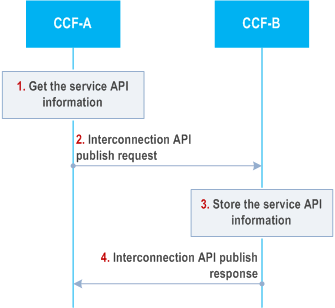
Step 1.
CCF-A gets the service APIs to be shared with CCF-B from the API publish function which is in the same CAPIF provider domain of CCF-A as described in subclause 8.3.3, or from another CCF as described in this procedure.
Step 2.
Based on the shareable information for the service API or the service API category information, the CCF-A determines to publish the service API or the service API category information to the CCF-B. The CCF-A sends the interconnection API publish request to CCF-B with the details of at least one of service APIs or the category information of the service APIs, along with the identity information of CCF-A, shareable information and CAPIF provider domain information if allowed to share. The API topology hiding may be enabled.
Step 3.
CCF-B stores the service API information or service API category provided by the CCF-A.
Step 4.
CCF-B provides an interconnection API publish response to the CCF-A indicating success or failure result and triggers notifications to subscribed API invokers as described in subclause 8.8.4.
8.25.3.2 Service API discovery involving multiple CCFs p. 85
This subclause describes a procedure for service API discovery involving multiple CCFs
Pre-conditions:
- CCF-A and CCF-B connect to each other, and either belong to the single trust domain of the same CAPIF provider or trust domains of different CAPIF providers.
- When CCF-A and CCF-B belong to trust domains of different CAPIF providers, the two CAPIF providers have business agreement for service API sharing.
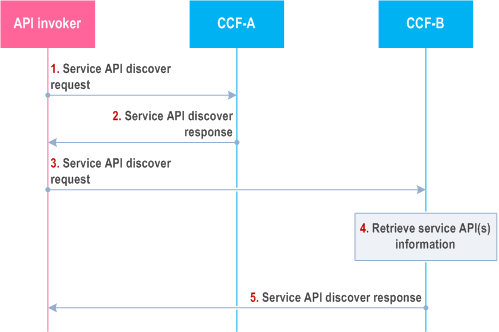
Step 1.
The API invoker sends a service API discover request to the CCF-A. It includes the API invoker identity and query information.
Step 2.
The CCF-A verifies the identity of the API invoker and retrieves the stored service API(s) information and service API categories. The information of CCF-B with the service API category matching the discovery criteria is returned to API invoker in the service API discover response.
Step 3.
The API invoker sends an service API discover request to the CCF-B. The identity of API invoker is included. The query information is also provided.
Step 4.
Upon receiving the service API discover request, the CCF-B verifies the identity of the API invoker. The CCF-B retrieves the stored service API(s) information as per the query information in the service API discover request. Further, the CCF-B applies the discovery policy and performs filtering of service APIs information which matches the discovery criteria.
Step 5.
The CCF-B sends an service API discover response to the API invoker with the list of service API information for which the API invoker has the required authorization.
8.25.3.3 Service API discovery for CAPIF interconnection p. 86
This subclause describes a procedure for service API discovery for CAPIF interconnection. The CCF-A and the CCF-B may belong to the same CAPIF provider domain or different CAPIF provider domains. When the CCF-A and the CCF-B belong to different CAPIF provider domains, the two CAPIF providers shall have business agreement for service API discovery.
Pre-conditions:
- The CCF-A is configured with the CCF-B information.
- The CCF-B is configured with the CCF-A information.
- The CCF-A is triggered (e.g. API invoker service API discovery, periodic service API discovery) to perform service API discovery with the CCF-B.
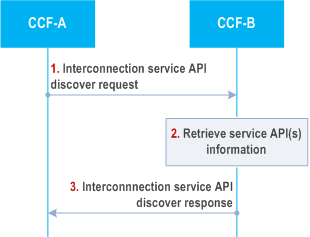
Step 1.
The CCF-A sends the interconnection service API discover request to the CCF-B. The identity of the CCF-A and the query information are included.
Step 2.
The CCF-B upon receiving the interconnection service API discover request verifies the identity of the CCF-A. The CCF-B retrieves the stored service API(s) or the CCF(s) information as per the query information in the interconnection service API discover request. Further, the CCF-B applies the discovery policy and performs the filtering of service APIs or the CCF(s) information. The topology hiding policy may be applied to the retrieved list of service API information.
Step 3.
The CCF-B sends the interconnection service API discover response to the CCF-A with the list of service API information for which the CCF-A has the required authorization or the CCF(s) information that matches the discovery criteria.
8.25.3.4 Service API unpublish for CAPIF interconnection |R19| p. 87
This clause describes the procedure for service API unpublish for CAPIF interconnection.
Pre-condition:
- CCF-A sends an interconnection API unpublish request to CCF-B. The request includes a service API published information reference. If the shareable information IE was present in the interconnection API publish request (see clause 8.25.2.1), the API unpublish request should be forwarded to the provided list of CAPIF provider domain information during the publish procedure.
- CCF-B is configured as the designated CAPIF core function in the trust domain of CAPIF provider A.
- CCF-A has successfully published service APIs to the designated CCF (i.e., CCF-B) using the procedure in clause 8.25.3.1.
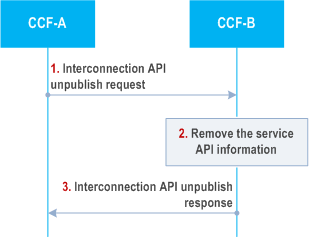
Step 1.
CCF-A sends an interconnection API unpublish request to CCF-B. The request may include a set of (previously published) service API information. If the shareable information IE was present in the interconnection API publish request (see clause 8.25.2.1), the API unpublish request should be forwarded to the provided list of CAPIF provider domain information during the publish procedure.
Step 2.
Upon receiving the interconnection API unpublish request, the CCF-B checks whether the CCF-A is authorized to unpublish service APIs. If the check is successful, CCF-B will remove the requested service API information from the API registry.
Step 3.
CCF-B sends an interconnection API unpublish response to CCF-A containing the operation result and triggers notifications to subscribed API invokers (if any) as described in subclause 8.8.4.
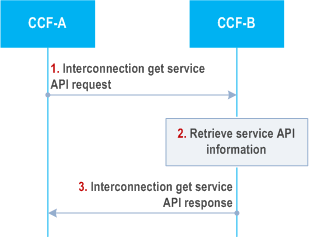
8.25.3.5 Retrieve service APIs for CAPIF interconnection |R19| p. 88
This clause describes the procedure to retrieve service APIs information in a CAPIF interconnection scenario.
Pre-condition:
- CCF-A and CCF-B connect to each other, and either belong to the single trust domain of the same CAPIF provider or trust domains of different CAPIF providers. When CCF-A and CCF-B belong to trust domains of different CAPIF providers, the two CAPIF providers have business agreement for service API sharing.
- CCF-B is configured as the designated CAPIF core function in the trust domain of CAPIF provider A.
Step 1.
CCF-A sends an interconnection get service API request to CCF-B with service API published information reference provided by the CAPIF core function when the service API was published.
Step 2.
Upon receiving interconnection get service API request, CCF-B checks whether CCF-A is authorized to get the published service APIs information. If the check is successful, the corresponding service API information is retrieved from the CAPIF core function (API registry).
Step 3.
CCF-B sends a service API get response to CCF-A which includes the requested service API information if the retrieval operation was successful.
8.25.3.6 Update service APIs for CAPIF interconnection |R19| p. 89
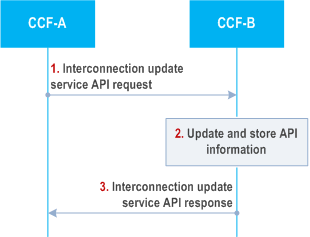
Figure 8.25.3.6-1 illustrates the procedure for updating the published service APIs information by a CAPIF core function.
Pre-conditions:
- CCF-A and CCF-B connect to each other, and either belong to the single trust domain of the same CAPIF provider or trust domains of different CAPIF providers. When CCF-A and CCF-B belong to trust domains of different CAPIF providers, the two CAPIF providers have business agreement for service API sharing.
- CCF-B is configured as the designated CAPIF core function in the trust domain of CAPIF provider A.
Step 1.
The CCF-A sends an interconnection update service API request to the CCF-B, including the information in Table 8.25.2.9-1.
Step 2.
Upon receiving the interconnection update service API request, the CCF-B checks whether the CCF-A is authorized to update the published service APIs information. If the check is successful, the service API information provided by the CCF-A is updated at the CCF-B (API registry).
Step 3.
The CCF-B provides an interconnection update service API response to the CCF-A containing the result of the update operation and triggers notifications to subscribed API invokers (if any) as described in subclause 8.8.4.


