Content for TS 23.222 Word version: 19.2.0


0…
4…
5…
6…
6.3…
6.4…
7…
8…
8.5…
8.8…
8.9…
8.13…
8.17…
8.21…
8.25…
8.26…
8.28…
8.30…
9…
10…
10.4…
10.7…
11…
A
B…
B.2…
B.3…
C…
D…
5 Involved business relationships
5.1 Basic CAPIF business relationships
5.2 CAPIF business relationships for RNAA
...
...
5 Involved business relationships p. 21
5.1 Basic CAPIF business relationships |R18| p. 21
Figure 5.1-1 shows the typical business relationships in CAPIF.
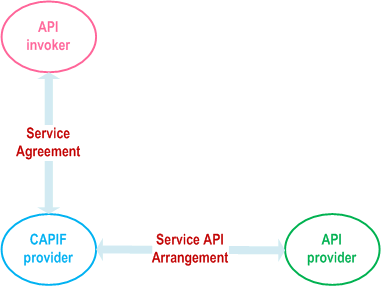
The API invoker is typically provided by a 3rd party application provider who has service agreement with a CAPIF provider.
The API provider hosts one or more service APIs and has a service API arrangement with CAPIF provider to offer the service APIs to the API invoker.
The CAPIF provider and the API provider can be part of the same organization (e.g. PLMN operator), in which case the business relationship between the two is internal to a single organization. The CAPIF provider and the API provider can be part of different organizations, in which case the business relationship between the two must exist.
5.2 CAPIF business relationships for RNAA |R18| p. 22
Figure 5.2-1 shows the CAPIF business relationships for the resource owner-aware northbound API access (RNAA).
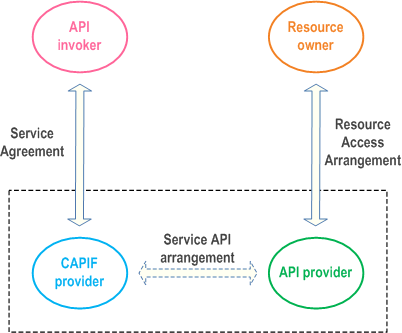
The business relationships the API invoker, the CAPIF provider, and the API provider follow the description in the clause 5.1. In addition to them, the resource owner is an entity capable of granting access to a protected resource related to the resource exposed by the API provider. The API invoker and the resource owner can be the same entity or separate entities. In the current release, the resource owner is a user of a UE and can provide authorization information using the UE.


