Content for TS 33.401 Word version: 17.3.0


1…
4
5…
6…
6.2…
7…
7.2.5…
7.2.8
7.2.9…
7.3…
8…
9…
10…
11…
15…
A…
B…
C…
C.1.6
C.2…
C.2.7
C.2.8
C.3…
C.4.7
D…
E…
E.2…
E.3…
F…
G…
H…
I…
K…
K Security for Integrated Access and Backhaul (IAB) in EN-DC
K.1 General
K.2 IAB-node integration procedure
L Security Aspects of DNS and ICMP
M Protection of management traffic between IAB-node and OAM
$ Change history
K (Normative) Security for Integrated Access and Backhaul (IAB) in EN-DC |R16| p. 167
K.1 General p. 167
This Annex provides the security procedures applied to IAB-node when connecting to EPC. The IAB reference architecture, when connected to EPC, is defined in TS 23.401.
IAB-node consists of a gNB-DU function and a UE function (referred to as IAB-UE). The IAB-UE function reuses UE procedures defined in this document to connect to EPC.
In an IAB (Integrated Access and Backhaul) architecture, the IAB-node can access the network using either standalone mode or EN-DC mode. Overall description of IAB feature in standalone mode is in TS 38.300. The EN-DC specific details are defined in TS 36.331, TS 36.413, and TS 36.423.
When using the EN-DC mode, as shown in Figure K.1-1, the IAB-node connects via E-UTRA to a MeNB, and the IAB-donor terminates X2-C as SgNB.
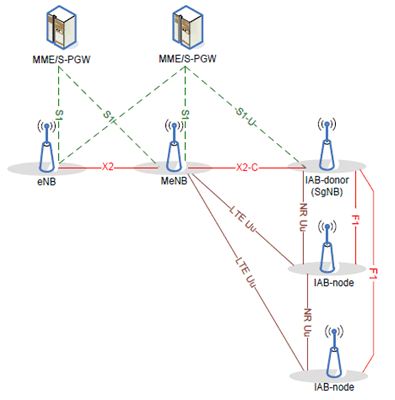
The present document only deals with security aspects of IAB in the EN-DC mode. The security aspects of IAB in standalone mode (including authentication and authorization of IAB-nodes, and security of F1 interfaces) are defined in TS 33.501.
K.2 IAB-node integration procedure p. 167
K.2.1 Authentication and Authorization of IAB-node p. 167
The IAB-UE function shall behave as a UE, and shall reuse the UE procedures specified in this specification, when connecting to EPC, for the authentication, key derivation and distribution scheme, subscription credential(s) storage requirements, NAS security and AS security.
Authorization of IAB-nodes shall be performed by the EPC supporting IAB architecture as described in TS 23.401.
A summary of Authentication and Authorization of IAB-node is illustrated in Figure K.2-1.
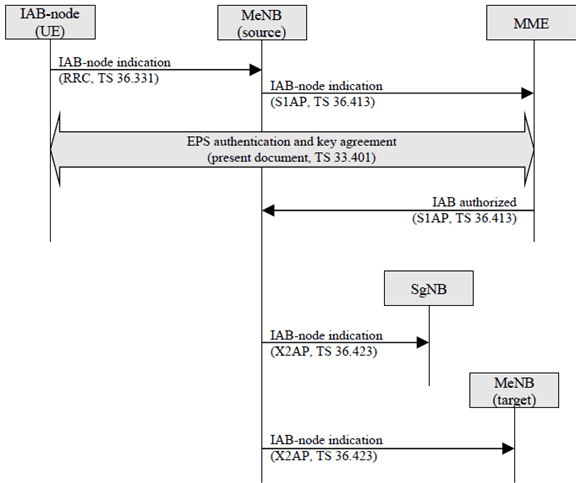
Figure K.2-1: Summary of authentication and authorization of IAB-nodes
(⇒ copy of original 3GPP image)
(⇒ copy of original 3GPP image)
- The indication of being an IAB-node is signalled from the IAB-node to the eNB as defined in TS 36.331.
- This indication is signalled from the eNB to the MME as defined in TS 36.413.
- Mutual authentication between the IAB-node and the EPC supporting the IAB architecture shall be performed using the authentication and key agreement procedure defined in the clause 6.1 of the present document.
- After successful authentication and validity check, the indication that the IAB-node is authorized is signalled from the MME to the eNB as defined in TS 36.413.
- During EN-DC procedures, the indication of IAB-node is signalled from the MeNB to the SgNB as defined in TS 36.423.
- During handover procedures, the indication of IAB-node is signalled from the one eNB to another eNB as defined in TS 36.423.
L Security Aspects of DNS and ICMP |R16| p. 169
L.1 General p. 169
M (Normative) Protection of management traffic between IAB-node and OAM |R16| p. 170
If management traffic uses the user plane via PDN session, it shall be protected using the user plane security mechanism as specified in the present document.
$ Change history p. 171

