Tech-invite3GPPspaceIETFspace
21222324252627282931323334353637384‑5x

Content for  TS 26.501  Word version:  19.2.0

Top   Top   Up   Prev   Next
1…   4…   4.1…   4.2…   4.3…   4.4   4.5…   4.6…   4.7…   4.8   4.9…   4.10…   4.11…   5…   5.2…   5.2.4   5.2.5…   5.3…   5.3.2…   5.4…   5.5…   5.6…   5.7…   5.7.4…   5.7.8   5.7.9…   5.8…   5.10…   5.10.3   5.10.4   5.10.5…   5.10.6…   5.10.7   5.11…   5.12…   5.12.3   5.12.4…   5.12.5…   5.13…   5.14…   6…   6.2…   6.2.2.2…   6.2.3…   6.3…   6.4…   6.8…   6.9…   6.9.5…   6.9.7   6.9.8…   7…   8…   8.2   9…   A…   A.4…   A.8…   A.11…   A.13…   A.15…   A.16…   B…   C…   D…   E…   F…   G…   G.2…   G.3…   H…


4.2  5G unicast downlink Media Streaming architecturep. 32

4.2.1  Standalone - Non-Roamingp. 32

The 5GMSd Application Provider uses 5GMSd functions for downlink streaming services. It provides a 5GMSd-Aware Application on the UE the ability to make use of 5GMSd Client and network functions using 5GMSd interfaces and APIs.
The architecture in Figure 4.2.1-1 below represents the specified 5GMSd functions within the 5G System (5GS) as defined in TS 23.501. Three main functions are defined:
  • 5GMSd AF: An Application Function similar to that defined in clause 6.2.10 of TS 23.501, dedicated to 5G Downlink Media Streaming.
  • 5GMSd AS: An Application Server dedicated to 5G Downlink Media Streaming.
  • 5GMSd Client: A UE internal function dedicated to 5G Downlink Media Streaming. The 5GMSd Client is a logical function and its subfunctions may be distributed within the UE according to implementation choice.
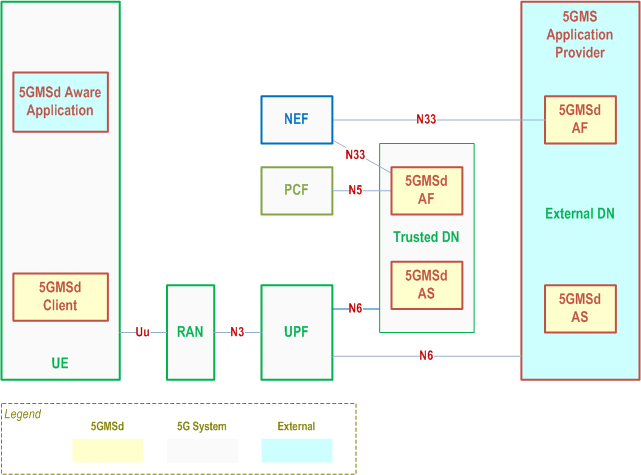
5GMSd AF and 5GMSd AS are Data Network (DN) functions and communicate with the UE via the User Plane Function (UPF) using the N6 reference point as defined in TS 23.501.
Functions in trusted DNs are trusted by the operator's network as illustrated in Figure 4.2.3-5 of TS 23.501. Therefore, AFs in trusted DNs may directly communicate with relevant 5G Core functions.
Functions in external DNs, i.e. 5GMSd AFs in external DNs, may only communicate with 5G Core functions via the NEF using reference point N33.
Copy of original 3GPP image for 3GPP TS 26.501, Fig. 4.2.1-1: Downlink 5G Media Streaming within 5G System
Up
The architecture in Figure 4.2.1-2 below represents the media architecture connecting UE internal functions and related network functions.
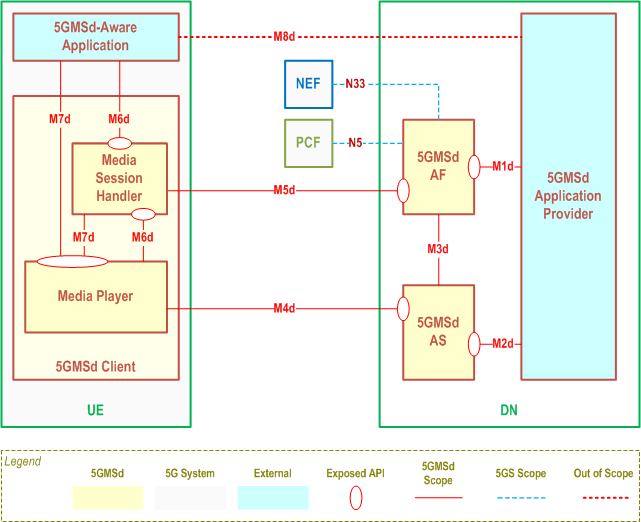
Copy of original 3GPP image for 3GPP TS 26.501, Fig. 4.2.1-2: Media architecture for unicast downlink media streaming
Up
The following functions are defined:
  • 5G Media Streaming Client for downlink (5GMSd Client) on the UE: Receiver of 5GMS downlink media streaming service that may be accessed through well-defined interfaces/APIs. Alternatively, the UE may be implemented in a self-contained manner such that interfaces M6d and M7d are not exposed at all.
  • The 5GMSd Client contains two subfunctions:
    • Media Session Handler: A function on the UE that communicates with the 5GMSd AF in order to establish, control and support the delivery of a media session, and may perform additional functions such as consumption and QoE metrics collection and reporting. The Media Session Handler may expose APIs that can be used by the 5GMSd-Aware Application. The Media Session Handler may be launched by a 3GPP-defined Service URL (see clause 4.10).
    • Media Player: A function on the UE that communicates with the 5GMSd AS in order to stream media content in real time or download media content in non-real time (e.g., for later consumption) and that may provide APIs to the 5GMSd-Aware Application for media playback and to the Media Session Handler for media session control. The Media Player supports the following features:
      • Handling of Media Player Entries (and relevant auxiliary documents referenced by Media Player Entries) describing a media streaming presentation (e.g. MPD for DASH content, URL to a video clip file, etc.); and, if necessary, supplementary information describing a downlink media streaming configuration that should be used to access content (i.e., information needed by the Media Player to access content referenced by the media streaming presentation, but auxiliary to the media streaming presentation itself).
      • Functionality to access media using the downlink streaming configuration indicated by a Media Player Entry (and any relevant auxiliary documents referenced by that Media Player Entry). This may include the functionality to decrypt DRM encrypted media, switch between service locations, utilize a network-side function for the purposes of guiding or steering access to different service locations, use of multiple service locations in parallel, etc.
  • 5GMSd-Aware Application: The 5GMSd Client is typically controlled by an external media application, e.g. an App, which implements external application or content service provider specific logic and enables a media session to be established. The 5GMSd-Aware Application is not defined within the 5G Media Streaming specifications, but the function makes use of 5GMSd Client and network functions using 5GMSd interfaces and APIs.
  • 5GMSd AS: An Application Server which hosts 5G media functions. Note that there may be different realizations of the 5GMSd AS, including the distribution of 5GMSd AS functionality between different physical hosts, for example in a Content Delivery Network (CDN).
    The 5GMSd AS supports the following features:
    1. Content Hosting, including:
      • Ingesting media content from a 5GMSd Application Provider at reference point M2d.
      • Redistributing media content at reference point M10d to support exposure of M4d service locations from different client-facing instances of the logical 5GMSd AS in a deployed 5MGS System, reducing the need to ingest the same content repeatedly at reference point M2d.
      • Caching media content to reduce the need to ingest the same content repeatedly at reference point M2d.
      • A generic framework for content preparation, including the capability to (re-)encode media objects that have been ingested at reference point M2d.
      • Geographic restrictions on content access by the Media Player at reference point M4d ("geofencing").
      • Domain Name aliasing at reference point M4d.
      • Support for server certificates at reference point M4d.
      • URL path rewriting at reference point M4d.
      • URL signing at reference point M4d.
    2. Processing of client data received from the Media Player at reference point M4d, including:
      • Reformatting and aggregation of the received information and reporting it to the 5GMSd AF via reference point M3d.
      • Proactively requesting media segments from the 5GMSd Application Provider at reference point M2d based on the received information, if this optional feature is supported.
  • 5GMSd Application Provider: External application or content-specific media functionality, e.g., media creation, encoding and formatting that uses 5GMSd interfaces to stream media to 5GMSd-Aware Applications. The 5GMSd Application Provider may also host media streaming content (e.g. content hosting, DRM server, etc.) for the purpose of streaming to the Media Player outside the scope of the 5GMS System via reference point M13d.
  • 5GMSd AF: An Application Function that provides various control functions to the Media Session Handler on the UE and/or to the 5GMSd Application Provider. It may relay or initiate a request for different Policy or Charging Function (PCF) treatment or interact with other network functions via the NEF. If configured, it may also handle aggregated client data submitted by the 5GMSd AS at reference point M3d.
The following interfaces are defined for 5G Downlink Media Streaming:
  • M1d (5GMSd Provisioning API): External API, exposed by the 5GMSd AF which enables the 5GMSd Application Provider to provision the usage of the 5G Media Streaming System for downlink media streaming and to obtain feedback.
  • M2d (5GMSd Ingest API): Optional External API exposed by the 5GMSd AS used when the 5GMSd AS in the trusted DN is selected to host content for the streaming service.
  • M3d: Internal API used by a 5GMSd AF to configure and manage a 5GMSd AS instance.
  • M4d (Media Streaming APIs): APIs exposed by a 5GMSd AS to the Media Player to stream media content in real time or download media content in non-real time.
  • M5d (Media Session Handling API): APIs exposed by a 5GMSd AF to the Media Session Handler for media session handling, control, reporting and assistance that also include appropriate security mechanisms, e.g. authorization and authentication.
  • M6d (UE Media Session Handling APIs): APIs exposed by a Media Session Handler to the Media Player for client-internal communication, and exposed to the 5GMSd-Aware Application enabling it to make use of 5GMS functions. This API may be supported by a 3GPP-defined Service URL (see clause 4.10).
  • M7d (UE Media Player APIs): APIs exposed by a Media Player to the 5GMSd-Aware Application and Media Session Handler to make use of the Media Player.
  • M8d: (Application API): application interface used for information exchange between the 5GMSd-Aware Application and the 5GMSd Application Provider, for example to provide Service Access Information to the 5GMSd-Aware Application. This API is external to the 5G System and not specified by 5GMS.
  • M10d (Service Chaining interface): Interface between one instance of the 5GMSd AS and another for the purpose of distributed service chaining.
  • M11d (UE Media Session Handling and Media Player APIs): APIs exposed by the Media Session Handler and Media Player to each other for the purpose of client-internal communication.
  • M13d (External downlink Media Streaming interface): Interface exposed by the 5GMSd Application Provider to the Media Player offering access to media content and/or related resources. This reference point is not further defined by the present document.
The following subfunctions are identified as a part of a more detailed breakdown of the 5GMSd AS for stage 3 specifications:
  • Adaptive Bit Rate (ABR) Encoder, Encryption and Encapsulator.
  • Manifest (e.g. MPD) Generator and Segment (e.g. DASH) Packager.
  • Origin Server hosting content at one or more service locations, each of which may be assigned to an affinity group.
  • CDN Server (e.g. Edge Servers).
  • DRM Server (e.g. DRM License Server).
  • Service Directory.
  • Content Guide Server.
  • Replacement content server (e.g. Ad content server).
  • Manifest Proxy, i.e. MPD modification server.
  • App Server.
  • Session Management Server.
  • Media object encoding and/or packaging.
A breakdown of 5GMSd functions in the UE is provided in clause 4.2.2 below.
Up

4.2.2  5GMSd UE functionsp. 37

The UE may include many detailed subfunctions that can be used individually or controlled individually by the 5GMSd-Aware Application. This clause breaks down several relevant identified subfunctions for which stage 3 specification is available.
The 5GMSd-Aware Application itself may include many functions that are not provided by the 5GMSd Client or by the 5G UE. Examples include service and content discovery, notifications and social network integration. The 5GMSd-Aware Application may also include functions that are equivalent to ones provided by the 5GMSd Client and may only use a subset of the 5GMSd client functions. The 5GMSd-Aware Application may act based on user input or may for example also receive remote control commands from the 5GMSd Application Provider through M8d.
With respect to Media Player functions, Figure 4.2.2-1 below shows more detailed functional components of a UE for media player functions to access the 5GMSd AS.
Copy of original 3GPP image for 3GPP TS 26.501, Fig. 4.2.2-1: Downlink 5G Media Streaming UE functions (Media Player centric)
Up
The following subfunctions are identified as part of a more detailed breakdown of the Media Player function:
  • Media Access Client: Accesses media content, such as DASH-formatted media segments, for immediate or delayed consumption.
  • Application Provider Access Client (optional): When present, accesses resources and data, possibly including media content, such as DASH-formatted media segments, from the 5GMSd Application Provider for immediate or delayed consumption. This function is not defined within the present document.
  • Media Decapsulation: Extracts the elementary media streams for decoding and provides media system related functions such as time synchronization, capability signalling, accessibility signalling, etc.
  • Consumption Measurement and Logging Client: Performs the measurement and logging of content consumption-related information in accordance with the Consumption Reporting Configuration part of provisioning data, supplied by the 5GMSd Application Provider to the 5GMSd AF, and forwarded by the 5GMSd AF to the Media Player via the Media Session Handler.
  • Metrics Measurement and Logging Client: Performs the measurement and logging of QoE metrics in accordance with the Metrics Reporting Configuration part of provisioning data, supplied by the 5GMSd Application Provider to the 5GMSd AF, and forwarded by the 5GMSd AF to the Media Player via the Media Session Handler.
  • In-band client data reporting client (not depicted): Functionalities in the Media Player to report client data to the 5GMSd AS as part of media requests the Media Player makes at reference point M4d.
  • DRM Client (optional): When present, the DRM client might or might not be a part of the Media Player. It provides a content protection mechanism with its unique key management and key delivery system, authentication/authorization, policy enforcement and entitlement check. The DRM Client is not defined within 5G Media Streaming specifications.
  • Media Decryption (optional): When present, media decryption is responsible to decrypt the media samples using the keys provided in the DRM license, and further passing to the Media Decoder to enable playback of encrypted media. The media decryption and media decoding could be implemented on a general-purpose processor in software or hardware or, for a more secure and robust architecture, the decryption, decoding and rendering could be implemented on the hardware of secure processors.
  • Media Decoder: Decodes the media, such as audio or video.
  • Media Presentation and Rendering: Presents the media using an appropriate output device and enables possible interaction with the media.
With respect to the Media Session Handler, Figure 4.2.2-2 below shows more detailed functional components of a UE to access the 5GMSd AF.
Copy of original 3GPP image for 3GPP TS 26.501, Fig. 4.2.2-2: Downlink 5G Media Streaming UE functions (control-centric)
Up
The following subfunctions are identified as part of a more detailed breakdown of Media Session Handler:
  • Core Functions: Realization of a "session" concept for media communications, optionally spanning multiple stateless sessions. May optionally interact with a network-based 5GMSd AF.
  • Metrics Collection and Reporting: executes the collection of QoE metrics measurement logs from the Media Player and sending of metrics reports to the 5GMSd AF for the purpose of metrics analysis or to enable potential transport optimizations by the network.
  • Consumption Collection and Reporting: executes the collection of content consumption measurement logs from the Media Player and sending of consumption reports to a 5GMSd AF about the currently consumed media within the available presentation, about the UE capabilities and about the environment of the media session for potential transport optimizations by the network or consumption report analysis.
  • Dynamic Policy: involves interacting with the 5GMSd AF to instantiate Policy Templates that change the network Quality of Service for a media streaming session. Policy Templates may be selected based on interactions with the Media Player.
    • When the L4S enablement flag is present on a Policy Template, the 5GMSd Client assumes that 5GMSd AS supports the detection of congestion and reaction to it.
    • When a QoS monitoring configuration is present in the Policy Template, the 5GMSd Client may enable the monitoring of the QoS parameters listed in that configuration.
  • Network Assistance: downlink streaming delivery assisting functions provided by the network to the 5GMSd Client and Media Player in the form of bit rate recommendation (or throughput estimation) and/or delivery boost. Network Assistance functionality may be supported by 5GMSd AF or ANBR-based RAN signalling mechanisms. This function also includes the logging of ANBR-based Network Assistance invocations and their reporting via reference point R2, as defined in clause 4.7.1.
  • Service URL Handling: a UE function that handles 3GPP Service URLs (see clause 4.10) to support the launch of 5GMSd services and associated functions in the UE and in the network.
  • In-band client data reporting configuration: Configuration of Media Player via reference point M11d, based on information received via M5d, instructing it to initiate client data collection and in-band reporting at reference point M4d.
Up

4.2.3  Service Access Information for downlink media streamingp. 40

The Service Access Information is the set of parameters and addresses which are needed by the 5GMSd Client to activate and control the reception of a downlink streaming session, and to report service/content consumption and/or QoE metrics.
The Service Access Information may be provided together with other service announcement information using M8d. Alternatively, the 5GMSd Client fetches the Service Access Information from the 5GMSd AF. The Service Access Information may be provided as, or may be accessed via, a 3GPP-defined Service URL that provides a unique resolvable identifier to the 5GMSd Provisioning Session and that may also include a reference to the Media Player Entry. Regardless of how it is provided, the Service Access Information contains different information, depending on the collaboration model between the 5GMS System and the 5GMSd Application Provider, and also depending on offered features. Baseline parameters are listed in Table 4.2.3-1 below:
Parameters Description
Provisioning Session identifierUnique identification of the M1d Provisioning Session.
When the content hosting feature is activated for a downlink streaming session, the parameters from Table 4.2.3-1a below can additionally be present.
Parameters Description
Media Entry Points
(Media Player Entries)
A set of pointers to documents that provide additional details for different downlink streaming session configurations and/or define equivalent media presentations (see NOTE), e.g. MPD for DASH content or URL to a video clip file.
Each member of the set may specify additional details to aid selection by the 5GMS Client, including content type, profile indicators and precedence.
A Media Player Entry document may additionally include:
  • Service Descriptions, each one identified by an External reference that enables it to be matched with a Policy Template, and each describing the set of media streaming parameters (e.g., bit rate, target latency) that realise a Service Operation Point.
  • Service configuration information (e.g. location and configuration information for the purposes of accessing content from multiple service locations either internal or external to the 5GMS System).
A Media Player Entry URL may be embedded in a 3GPP Service URL.
NOTE:
An equivalent media presentation is one which has the same content but may result in a different Quality of Experience.
When the consumption reporting feature is activated for a downlink streaming session, the parameters from Table 4.2.3-2 below are additionally present.
Parameters Description
Reporting intervalIdentifies the interval between consumption reports being sent by the Media Session Handler.
Server address A list of 5GMSd AF addresses where the consumption reports are sent by the Media Session Handler.
Sample percentageThe proportion of clients that shall report media consumption.
If not specified, all clients shall send reports.
Location reportingIdentify whether the Media Session Handler provides location data to the 5GMSd AF (in case of MNO or trusted third parties)
When the dynamic policy invocation feature is activated for a downlink streaming session the parameters from Table 4.2.3-3 below are additionally present.
Parameters Description
Server addressA list of 5GMSd AF addresses (in the form of opaque URLs) which offer the APIs for dynamic policy invocation sent by the 5GMS Media Session Handler.
Valid Policy Template IdsA list of Policy Template identifiers which the 5GMSd Client is authorized to use.
Service Data Flow MethodsA list of recommended Service Data Flow description methods (descriptors), e.g. 5-Tuple, ToS, 2-Tuple, etc, which should be used by the Media Session Handler to describe the Service Data Flows for the traffic to be policed.
External referenceAdditional identifier for this Policy Template that can be cross-referenced with external metadata about the streaming session.
The same external reference may appear on more than one dynamic policy invocation configuration within the scope of the same Provisioning Session provided the parameters below differ in the underlying Policy Template.
L4S enablement preferenceA flag indicating a preference that ECN marking for L4S functionality is enabled for Dynamic Policies instantiating this Policy Template.
The 5GMSd Client should not instantiate this Policy Template unless it supports L4S.
QoS monitoring enablement preferenceA flag indicating a preference that QoS monitoring functionality is enabled for Dynamic Policies instantiating this Policy Template.
When the metrics collection and reporting feature is activated for a downlink streaming session, one or more parameter sets for metrics configuration, according to Table 4.2.3-4, are additionally present. Each metrics configuration set contains specific settings valid for that configuration, which is typically metric scheme dependent, and collection and reporting shall be done separately for each set.
Parameters Description
SchemeThe scheme associated with this metrics configuration set. A scheme may be associated with 3GPP or with a non-3GPP entity. If not specified, a default 3GPP metrics scheme shall apply.
Metrics schemes shall be uniquely identified by URIs.
Server addressA list of 5GMSd AF addresses to which metric reports shall be sent for this metrics configuration set.
DNNThe Data Network Name (DNN) which shall be used when sending metrics report for this metrics configuration set.
If not specified, the default DNN shall be used.
Slice scopeA list of network slice(s) for which metrics collection and reporting shall be executed for this metrics configuration set.
If not specified, the metrics collection and reporting shall be done for all network slices.
Reporting intervalThe sending interval between metrics reports for this metrics configuration set.
If not specified, a single final report shall be sent after the streaming session has ended.
Sample percentageThe proportion of streaming sessions that shall report metrics for this metrics configuration set.
If not specified, reports shall be sent for all sessions.
Streaming source filterA list of content URL patterns for which metrics reporting shall be done for this metrics configuration set.
If not specified, reporting shall be done for all URLs.
Communication Service typeThe type of Communication Service (Unicast and/or MBS broadcast and/or MBS multicast) for which metrics collection and reporting is requested.
If not specified, metrics collection and reporting shall be performed for all communication service types.
MetricsA list of metrics which shall be collected and reported for this metrics configuration set.
For progressive download and DASH streaming services, the listed metrics are associated with the 3GPP metrics scheme and shall correspond to one or more of the metrics as specified in clauses 10.3 and 10.4, respectively, of TS 26.247.
In addition, for the 3GPP metrics scheme as applied to DASH streaming, the quality reporting scheme and quality reporting protocol as defined in clauses 10.5 and 10.6, respectively, of TS 26.247 shall be used.
If not specified, a complete (or default if applicable) set of metrics will be collected and reported.
When in-band client data reporting is activated for a downlink streaming session the parameters defined in clause K.3.7 of ISO/IEC 23009-1 [29] may be present as part of the relevant metrics configuration set. (These parameters are used to activate in-band client data reporting in case the Media Player Entry does not include in-band client data reporting configuration information.)
When 5GMSd AF-based Network Assistance is activated for a downlink streaming session the parameters from Table 4.2.3-5 below shall be additionally present.
Parameters Description
Server address5GMSd AF address that offers the APIs for 5GMSd AF-based Network Assistance, accessed by the 5GMSd Media Session Handler. The server address shall be an opaque URL, following the 5GMS URL format.
Up

Up   Top   ToC