| |
| Figure 4.1 | Plug-in UICC |
| Figure 4.2 | Mini-UICC |
| Figure 4.3 | 4FF |
| Table 4.1 | Temperature range for full operational use and storage for specific UICC environmental conditions |
| Table 5.1 | Electrical characteristics of Vcc under normal operating conditions |
| Table 5.2 | Electrical characteristics of RST under normal operating conditions |
| Table 5.3 | Electrical characteristics of CLK under normal operating conditions |
| Table 5.4 | Electrical characteristics of I/O under normal operating conditions |
| Table 5.5 | Electrical characteristics of Vcc under normal operating conditions |
| Table 5.6 | Electrical characteristics of RESET (RST) under normal operating conditions |
| Table 5.7 | Electrical characteristics of Clock (CLK) under normal operating conditions |
| Table 5.8 | Electrical characteristics of I/O under normal operating conditions |
| Table 5.9 | Electrical characteristics of Vcc under normal operating conditions |
| Table 5.10 | Electrical characteristics of RESET (RST) under normal operating conditions |
| Table 5.11 | Electrical characteristics of Clock (CLK) under normal operating conditions |
| Table 5.12 | Electrical characteristics of I/O under normal operating conditions |
| Table 5.13 | Electrical characteristics of Vcc under normal operating conditions |
| Table 5.14 | Electrical characteristics of RESET (RST) under normal operating conditions |
| Table 5.15 | Electrical characteristics of Clock (CLK) under normal operating conditions |
| Table 5.16 | Electrical characteristics of I/O under normal operating conditions |
| Table 6.1 | Supply voltage classes indicated in ATR |
| Table 6.2 | Void |
| Table 6.3 | Maximum power consumption of the UICC during the UICC session |
| Table 6.4 | Minimum power supply by the terminal during the UICC session |
| Table 6.5 | Void |
| Table 6.6 | Complement to the I/O characteristics under normal operating conditions when Di = 64 is supported |
| Table 6.7 | Coding of the first tB |
| Figure 6.1 | Reaction to resets |
| Figure 7.1 | Layers |
| Figure 7.2 | Character frame |
| Table 7.1 | Procedure byte coding |
| Table 7.2 | Status byte coding |
| Figure 7.3 | Character waiting time |
| Figure 7.4 | Block waiting time |
| Figure 7.5 | Block guard time |
| Table 7.3 | Block frame structure |
| Table 7.4 | Node address byte |
| Table 7.4a | LSI number encoding |
| Table 7.5 | Coding of PCB for an I-block |
| Table 7.6 | Coding of PCB for an R-block |
| Table 7.7 | Bit b4 to b1 in the PCB for the R-block |
| Table 7.8 | Coding of PCB for an S-block |
| Table 7.9 | Bits b5 to b1 of PCB for an S-block |
| Table 7.10 | Information field |
| Figure 7.6 | |
| Figure 7.7 | |
| Figure 7.8 | |
| Figure 7.9 | |
| Figure 7.10 | |
| Figure 7.11 | |
| Figure 7.12 | |
| Figure 7.13 | |
| Table 7.11 | Definition of cases for data in APDUs |
| Figure 7.14 | |
| Figure 7.15 | |
| Figure 7.16 | |
| Figure 7.16a | |
| Figure 7.16b | |
| Table 7.12 | Minimum time-out value for execution of commands |
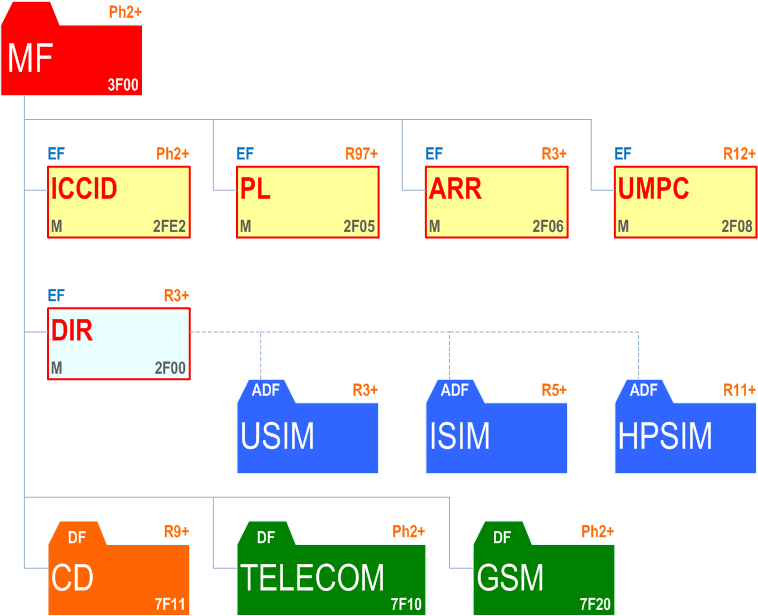
| Figure 8.1 | Example of an application structure |
| Figure 8.2 | Structure of a linear fixed file |
| Figure 8.3 | Structure of a cyclic file |
| Figure 8.4 | Example of a logical structure |
| Table 8.1 | File selection |
| Table 8.2 | Examples of file selection by path |
| Table 8.3 | |
| Table 9.0a | |
| Table 9.0b | |
| Table 9.0c | |
| Table 9.0d | |
| Table 9.1 | PIN mapping into SE |
| Table 9.2 | Access condition level coding |
| Table 9.3 | PIN mapping into key references |
| Table 9.4 | Usage qualifier coding for PS_DO |
| Table 9.5 | PS Template DO structure |
| Table 9.6 | PS Template DO structure when PS_DO usage qualifier is used |
| Table 10.1 | Contents of command APDU |
| Table 10.2 | Cases of C-APDUs |
| Table 10.3 | Coding of class byte for standard logical channels |
| Table 10.4 | Coding of Secure Messaging Indication for standard logical channels |
| Table 10.4a | Coding of class byte for extended logical channels |
| Table 10.4b | Coding of Secure Messaging Indication for extended logical channels |
| Table 10.5 | Coding of Instruction Byte of the Commands |
| Table 10.6 | Contents of Response APDU |
| Table 10.7 | Status byte coding - normal processing |
| Table 10.8 | Status byte coding - postponed processing |
| Table 10.9 | Status byte coding - warnings |
| Table 10.10 | Status byte coding - execution errors |
| Table 10.11 | Status byte coding - checking errors |
| Table 10.12 | Status byte coding - functions in CLA not supported |
| Table 10.13 | Status byte coding - command not allowed |
| Table 10.14 | Status byte coding - wrong parameters |
| Table 10.15 | Status byte coding - application errors |
| Table 10.16 | Commands and status words |
| Table 11.1 | Coding of P1 |
| Table 11.2 | Coding of P2 |
| Table 11.3 | Response for MF, DF or ADF with FCP template |
| Table 11.4 | Response for an EF with FCP template |
| Table 11.5 | File descriptor byte |
| Table 11.6 | UICC characteristics byte |
| Table 11.7a | Specific UICC environmental conditions byte |
| Table 11.7a1 | Coding of test configuration state |
| Table 11.7a2 | Coding of criterion type IDs |
| Table 11.7b | Coding of life cycle status integer |
| Table 11.8 | Coding of P1 |
| Table 11.9 | Coding of P2 |
| Table 11.10 | Coding of P1 |
| Table 11.11 | Coding of P2 |
| Table 11.12 | Coding of P2 |
| Table 11.13 | Coding of the first byte of the search indication for enhanced search mode |
| Table 11.14 | Coding of P1 |
| Table 11.15 | Coding of P2 |
| Table 11.16 | Coding of P1 |
| Table 11.17 | Coding of P1 |
| Table 11.18 | Coding of P2 |
| Table 11.18a | Coding of P1 |
| Table 11.19 | Coding of P1 |
| Table 11.20 | Coding of P2 |
| Table 11.20a | Coding of additional interfaces |
| Table 11.20b | Terminal capabilities for eUICC as defined in GSMA SGP.22 [33] |
| Table 11.20c | Terminal capabilities for eUICC as defined in GSMA SGP.32 [35] |
| Table 11.21a | Coding of P1 |
| Table 11.21b | Coding of P2 |
| Table 11.22 | Response Retrieve UICC endpoints |
| Table 11.23 | Coding of Data |
| Table 11.24 | Coding of Response Data |
| Table 11.25 | Coding of Data |
| Table 11.26 | Coding of the response data |
| Table 11.27 | Coding of the data |
| Table 11.28 | Coding of the response data |
| Table 11.29 | Coding of the data |
| Table 11.30 | Coding of P1 - Session control |
| Table 11.31 | Coding of P2 - Block Management |
| Table 11.32 | Coding of transmitted data |
| Table 11.33 | SW2 of '92 XX' |
| Table 11.34 | Void |
| Table 11.34a | Coding of P1 |
| Table 11.34b | Coding of P2 |
| Table 11.34c | Coding of P1 |
| Table 11.34d | Coding LSI options |
| Table 11.35 | Coding of P2 |
| Table 12.1 | Parameters for GET RESPONSE |
| Table 13.1 | EF |
| Table 13.2 | Coding of an application template entry |
| Table 13.3 | EF |
| Table 13.4 | EF |
| Table 13.5 | EF |
| Table 13.6 | EF |
| Table 13.7 | EF |
| Table 13.8 | EF |
| Figure B.1 | UICC states |
| Table F.1 | Access rule references for files located at the MF level |
| Table G.1 | Application Access Rule References |
| Table G.2 | DF Telecom Access Rule References |
| Figure I.1 | Modes of operation of a "Type 1 UICC" |
| Figure I.2 | Modes of operation of a "Type 2 UICC" |
| Figure J.1 | |
| Figure J.2 | |
| Figure K.1 | Example of multi verification capable UICC |
| Table L.1 | SET DATA with interruption, good case |
| Table L.2 | SET DATA with interruption, error case |
| Table L.3 | RETRIEVE DATA with interruption, good case |
| Table L.4 | RETRIEVE DATA with interruption, good case |
| Table L.5 | RETRIEVE DATA, short object |
| Table M.1 | ODD AUTHENTICATE with short data |
| Table M.2 | ODD AUTHENTICATE with extended data |
| Table M.3 | ODD AUTHENTICATE with short data |
| Table M.4 | ODD AUTHENTICATE with extended data |
| Table N.1 | Test configuration state transitions on a test UICC |
| Figure N.1 | State transitions of test configuration state on a UICC with a test configuration |
| Table O.1 | Example of NAA data in a test configuration criterion |