Content for TS 26.502 Word version: 17.3.0


4 Reference architecture for 5G Multicast-Broadcast User Services
4.1 General
4.2 System description
4.2.1 Network architecture
4.2.2 User Services network architecture
4.2.3 User Services Distribution methods
4.2.4 User Service Announcement
4.2.5 User Services Reception Reporting
4.2.6 Object Repair
...
...
4 Reference architecture for 5G Multicast-Broadcast User Services p. 10
4.1 General p. 10
This clause defines a reference architecture for 5G Multicast-Broadcast User Services, including the logical functions involved and the logical reference points between them.
Interworking with LTE is specified in clause 5.2 of TS 23.247 and its use in the context of MBS User Services is further specified in clauses 4.9 and A.1 of the present document.
4.2 System description p. 11
4.2.1 Network architecture p. 11
Figure 4.2.1-1 depicts the MBS network architecture defined in clause 5.1 of TS 23.247 using the reference point representation.
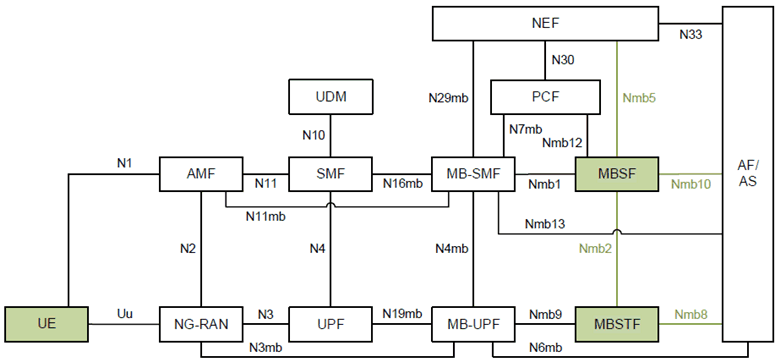
Figure 4.2.1-1: Network architecture for MBS User Services delivery and control
(⇒ copy of original 3GPP image)
(⇒ copy of original 3GPP image)
The functions and reference points involved in providing MBS User Services within the MBS System are highlighted in green. In particular:
- Reference point Nmb10 is used by the AF/AS to provision MBS User Services in the MBSF by invoking the Nmbsf service defined in clause 7.2.
- Reference point Nmb2 is used by the MBSF to configure and control MBS User Services distribution methods in the MBSTF by invoking the Nmbstf service defined in clause 7.3.
- Reference point Nmb8 is used by the MBSTF to ingest content from the AF/AS.
4.2.2 User Services network architecture p. 11
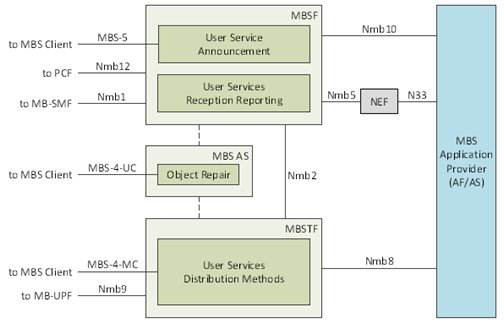
MBS User Services enable high-level applications to make use of the low-level features of the MBS System. An MBS User Service is provided by the MBSF and MBSTF working in combination to support configuration option 2 and configuration option 3 defined in Annex A of TS 23.247. In addition to the Network Functions defined in [5], the MBS AS provides unicast services such as Object Repair. It enables a complete service offering to an end-user, via a set of APIs that allows the MBS Client to activate or deactivate reception of the service.
The MBS User Services architecture depicted in Figure 4.2.2-1 shows the MBS-related entities involved in providing MBS User Services delivery and control. These are described in the following clauses. The MBS Application Provider plays the role of the AF/AS.
4.2.3 User Services Distribution methods p. 12
The distribution methods defined for use by MBS User Services in clause 6 of the present document make use of MBS Sessions (see clause 4.1 of TS 23.247) to deliver MBS data packets to the MBS Client. The distribution methods may use either a multicast MBS Session or a broadcast MBS Session. A set of MBS distribution methods is provided by the MBSTF. These provide functionality such as security and key distribution, reliability control (by means of FEC techniques) and associated delivery procedures.
- Object Distribution Method: A distribution method that delivers discrete binary objects over an MBS Session. This may be used to support real-time distribution of media segments (as special objects) including Low-Latency CMAF segments. The use of MBS Sessions by the Object Distribution Method is specified in clause 6.1.
- Packet Distribution Method: A distribution method that supports streaming of packetized media data over an MBS Session where Service Data Units (SDUs) are conveyed to the UE as part of Protocol Data Units (PDUs) or IP flows. Examples of upper layer SDUs are generic IP/UDP datagrams. The use of MBS Sessions by the Packet Distribution Method is specified in clause 6.2.
4.2.4 User Service Announcement p. 12
The User Service Announcement provides service access information needed by the MBS Client to discover and activate the reception of one or more MBS User Services. User Service Announcements may be delivered via MBS Distribution Sessions (either in the same MBS Distribution Session as the advertised content, or else via a dedicated MBS Distribution Session called the MBS User Service Announcement Channel) or via a regular unicast PDU Session.
The baseline information conveyed in User Service Announcements is defined in clause 4.5.7.
4.2.5 User Services Reception Reporting p. 12
Reporting by the MBS Client to the MBSF is for further study and may be realised by instantiating the data collection and reporting architecture specified in TS 26.531 [11]. This may include, for example, dynamically adjusting the Application Layer FEC redundancy level in the MBSTF according to the Packet Error Rate (PER) reported by the MBS Client.
4.2.6 Object Repair p. 13
When using the Object Distribution Method, Object Repair may be provisioned by the MBS Application Provider. This feature allows an MBS Client to retrieve from the MBS AS (via reference point MBS-4-UC) missing portions of objects not received intact from the MBSTF at reference point MBS-4-MC.
Two types of Object Repair are defined by the present document:
- Object Repair during the MBS Distribution Session.
- Object Repair after the completion of the MBS Distribution Session, including a randomized back-off period for different MBS Clients in order to avoid overloading the MBS AS.


