| |
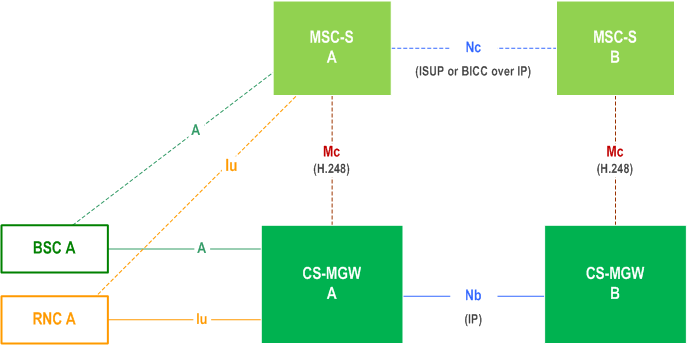
| Figure 1 | CS core network logical architecture |
| Figure 6.1 | Basic Mobile Originating Call, Forward Bearer Establishment (network model) |
| Figure 6.2 | Basic Mobile Originating Call, Forward Bearer Establishment (message sequence chart) |
| Figure 6.2-2 | Basic Mobile Originating Call, Forward Bearer Establishment (message sequence chart continue) |
| Figure 6.3 | Basic Mobile Originating Call, Backward Bearer Establishment (network model) |
| Figure 6.4 | Basic Mobile Originating Call, Backward Bearer Establishment (message sequence chart) |
| Figure 6.4-2 | Basic Mobile Originating Call, Backward Bearer Establishment (message sequence chart continue) |
| Figure 6.1.3-1 | Call Establishment for Iu on IP |
| Figure 6.1.4.1 | Basic Mobile Originating Call, Forward Bearer Establishment with Trace Session Activation (network model) |
| Figure 6.1.4.2 | Basic Mobile Originating Call, Forward Bearer Establishment with Trace Session Activation (message sequence chart) |
| Figure 6.1.4.2-2 | Basic Mobile Originating Call, Forward Bearer Establishment with Trace Session Activation (message sequence chart continue) |
| Figure 6.1.5.1 | Originating Call Establishment for AoIP |
| Figure 6.5 | Basic Mobile Terminating Call Forward Bearer Establishment (network model) |
| Figure 6.6 | Basic Mobile Terminating Call, Forward Bearer Establishment (message sequence chart) |
| Figure 6.6-2 | Basic Mobile Terminating Call, Forward Bearer Establishment (message sequence chart continue) |
| Figure 6.7 | Basic Mobile Terminating Call, Backward Bearer Establishment (network model) |
| Figure 6.8 | Basic Mobile Terminating Call, Backward Bearer Establishment (message sequence chart) |
| Figure 6.8-2 | Basic Mobile Terminating Call, Backward Bearer Establishment (message sequence chart continue) |
| Figure 6.2.3-1 | Terminating Call Establishment For Iu Interface on IP |
| Figure 6.2.4-1 | Terminating Call Establishment For AoIP |
| Figure 7.1 | Network Initiated Call Clearing (Network model) |
| Figure 7.2 | Network Initiated Call Clearing (message sequence chart) |
| Figure 7.3 | User Initiated Call Clearing (Network model) |
| Figure 7.4 | User Initiated Call Clearing (message sequence chart) |
| Figure 7.5 | MSC Server Initiated Call Clearing (Network model) |
| Figure 7.6 | MSC Server Initiated Call Clearing (message sequence chart) |
| Figure 7.7 | MGW Initiated Call Clearing (Network model) |
| Figure 7.8 | MGW Initiated Call Clearing (message sequence chart) |
| Figure 7.9 | Network Initiated Call Clearing (Network model) |
| Figure 7.10 | Network Initiated Call Clearing (message sequence chart) |
| Figure 8.1 | Intra-MSC SRNS Relocation (network model) |
| Figure 8.2 | Intra-MSC SRNS Relocation (message sequence chart) |
| Figure 8.2-2 | Intra-MSC SRNS Relocation (message sequence chart) |
| Figure 8.3 | Basic Inter-MSC SRNS Relocation (network model) |
| Figure 8.4 | Basic Inter-MSC SRNS Relocation (message sequence chart) |
| Figure 8.4-2 | Basic Inter-MSC SRNS Relocation (message sequence chart) |
| Figure 8.5 | Subsequent Inter-MSC SRNS Relocation back to the Anchor MSC (network model) |
| Figure 8.6 | Subsequent Inter-MSC SRNS Relocation back to the Anchor MSC (message sequence chart) |
| Figure 8.6-2 | Subsequent Inter-MSC SRNS Relocation back to the Anchor MSC (message sequence chart) |
| Figure 8.1.5-1 | SRNS Relocation with Iu on IP |
| Figure 8.1.6-1 | Intra-MSC Enhanced SRNS Relocation (network model) |
| Figure 8.1.6-2 | Intra-MSC Enhanced SRNS Relocation (message sequence chart) |
| Figure 8.1.7-1 | Enhanced SRNS Relocation with Iu on IP |
| Figure 8.7 | Intra-MSC UMTS to GSM Handover (network model) |
| Figure 8.8 | Intra-MSC UMTS to GSM Handover (message sequence chart) |
| Figure 8.8-2 | Intra-MSC UMTS to GSM Handover (message sequence chart) |
| Figure 8.2.1.10-1 | Intra-MSC UMTS to GSM Handover for AoIP (message sequence chart) |
| Figure 8.9 | Basic Inter-MSC UMTS to GSM Handover (network model) |
| Figure 8.10 | Basic Inter-MSC UMTS to GSM Handover (message sequence chart) |
| Figure 8.10-2 | Basic Inter-MSC UMTS to GSM Handover (message sequence chart) |
| Figure 8.2.2.3-1 | Basic Inter-MSC UMTS to GSM Handover for AoIP (message sequence chart) |
| Figure 8.11 | Subsequent Inter-MSC UMTS to GSM Handover back to the Anchor MSC (network model) |
| Figure 8.12 | Subsequent Inter-MSC UMTS to GSM Handover back to the Anchor MSC (message sequence chart) |
| Figure 8.12-2 | Subsequent Inter-MSC UMTS to GSM Handover back to the Anchor MSC (message sequence chart) |
| Figure 8.2.3.3-1 | Subsequent Inter-MSC UMTS to GSM Handover back to the anchor MSC for AoIP (message sequence chart) |
| Figure 8.13 | Intra-3G_MSC GSM to UMTS Handover (network model) |
| Figure 8.14 | Intra-3G_MSC GSM to UMTS Handover (message sequence chart) |
| Figure 8.15 | Basic Inter-MSC GSM to UMTS Handover (network model) |
| Figure 8.16 | Basic Inter-MSC GSM to UMTS Handover (message sequence chart) |
| Figure 8.16-2 | Basic Inter-MSC GSM to UMTS Handover (message sequence chart) |
| Figure 8.17 | Subsequent Inter-MSC GSM to UMTS Handover back to the Anchor MSC (network model) |
| Figure 8.18 | Subsequent Inter-MSC GSM to UMTS Handover back to the Anchor MSC (message sequence chart) |
| Figure 8.18-2 | Subsequent Inter-MSC GSM to UMTS Handover back to the Anchor MSC (message sequence chart) |
| Figure 8.3.5-1 | GSM to UMTS Handover with Iu on IP |
| Figure 8.19 | Intra-MSC GSM to GSM Handover (network model) |
| Figure 8.20 | Intra-MSC GSM to GSM Handover (message sequence chart) |
| Figure 8.20-2 | Intra-MSC GSM to GSM Handover (message sequence chart) |
| Figure 8.4.1.9-1 | Intra-MSC GSM to GSM Handover for AoIP (message sequence chart) |
| Figure 8.21 | Basic Inter-MSC GSM to GSM Handover (network model) |
| Figure 8.22 | Basic Inter-MSC GSM to GSM Handover (message sequence chart) |
| Figure 8.22-2 | Basic Inter-MSC GSM to GSM Handover (message sequence chart) |
| Figure 8.4.2.3-1 | Basic Inter-MSC GSM to GSM Handover for AoIP (message sequence chart) |
| Figure 8.23 | Subsequent Inter-MSC GSM to GSM Handover back to the Anchor MSC (network model) |
| Figure 8.24 | Subsequent Inter-MSC GSM to GSM Handover back to the Anchor MSC (message sequence chart) |
| Figure 8.24-2 | Subsequent Inter-MSC GSM to GSM Handover back to the Anchor MSC (message sequence chart) |
| Figure 8.4.3.3-1 | Subsequent Inter-MSC GSM to GSM Handover back to the anchor MSC for AoIP (message sequence chart) |
| Figure 8.4.5.8.1 | Intra-MSC BSS Internal Handover (network model) |
| Figure 8.4.5.8.2 | Intra-MSC BSS Internal Handover for AoIP (message sequence chart) |
| Figure 9.1 | TDM circuits used for A-interface (network model) |
| Figure 10.1 | Signalling connection failure |
| Figure 10.2 | MGW indicates the Failure/Maintenance locking |
| Figure 10.3 | Communication goes up |
| Figure 10.4 | MGW indicates recovery from a failure/or maintenance unlocking |
| Figure 10.5-1 | MGW Restoration |
| Figure 10.5-2 | MGW Registration |
| Figure 10.6 | (G)MSC Server Restoration |
| Figure 10.7 | Re-registration of an MGW |
| Figure 10.8 | Re-registration ordered by the (G)MSC server |
| Figure 10.9 | Removal from service of a Physical Termination |
| Figure 10.10 | Restoration to service of a Physical Termination |
| Figure 10.11 | Audit Value |
| Figure 10.12 | Audit Capability |
| Figure 10.13 | Capability Update |
| Figure 10.14 | (G)MSC Server Out of Service |
| Figure 10.15 | MGW Resource Congestion Handling - Activate |
| Figure 10.17 | MGW Resource Congestion Handling - Indication |
| Figure 10.15.1 | Inactivity Timeout - Activate |
| Figure 10.15.2 | Inactivity Timeout - Indication |
| Figure 10.16.1 | Termination heartbeat - Indication |
| Figure 13.1 | Call deflection (Network model) |
| Figure 13.2 | Call deflection (message sequence chart) |
| Figure 13.3 | CFU (Network model) |
| Figure 13.4 | CFU (message sequence chart) |
| Figure 13.5 | CFB; NDUB (Network model) |
| Figure 13.6 | CFB (NDUB) |
| Figure 13.7 | CFB; UDUB (Network model) |
| Figure 13.8 | CFB (UDUB) |
| Figure 13.9 | CFNRy (Network model) |
| Figure 13.10 | CFNRy (message sequence chart) |
| Figure 13.11 | CFNRc; Rerouting by VLR (Network model) |
| Figure 13.12 | CFNRc (Rerouting by VLR) (message sequence chart) |
| Figure 13.13 | Call Wait (network model) |
| Figure 13.14 | Call Confirmation of the Waiting Call |
| Figure 13.15 | Acceptance of the Waiting Call |
| Figure 13.16 | Call hold and establishment of a new call (Network model) example 1 |
| Figure 13.17 | Hold request (message sequence chart), example 1 |
| Figure 13.18 | Retrieval request (message sequence chart), example 1 |
| Figure 13.18a | Call hold and establishment of a new call (Network model) example 2 |
| Figure 13.18b | Hold request (message sequence chart), example 2 |
| Figure 13.18c | Retrieval request (message sequence chart), example 2 |
| Figure 13.19 | Multi Party call (Network model) |
| Figure 13.20 | Information flow for multi party call, internal ATM bearer (message sequence chart) |
| Figure 13.20a | Information flow for multi party call, internal IP bearer (message sequence chart) |
| Figure 13.20b | Private call (Network model) |
| Figure 13.20c | Information flow for private call (message sequence chart) |
| Figure 13.23 | ECT (Network model) |
| Figure 13.24 | Explicit call transfer; both calls answered (message sequence chart) |
| Figure 13.25 | Explicit call transfer; other call delivered (message sequence chart) |
| Figure 13.26 | Network initiated mobile originating call establishment with assignment after A and B party alerting (message sequence chart) |
| Figure 13.19-1 | GSM access Channel Mode Modify message |
| Figure 13.20.5-1 | VGCS call (termination overview for talker on dedicated channel) |
| Figure 13.20.5-2 | Talker on dedicated channel (Message sequence chart) |
| Figure 13.20.5-3 | VGCS call (termination overview for Talker on one channel model) |
| Figure 13.20.5-4 | Talker on one channel mode (Message sequence chart) |
| Figure 13.20.5-5 | Information flow talker move to uplink (Message sequence chart) |
| Figure 13.20.6-1 | Message sequence chart for a voice group call with AoIP when talker is on dedicated channel |
| Figure 14.1 | CAMEL Announcement Playing (message sequence chart) |
| Figure 14.2 | CAMEL User Interaction (message sequence chart) |
| Figure 14.1.3-1 | Initiate Call Attempt procedure (Network model) |
| Figure 14.1.3-2 | Information flow for Initiate Call Attempt (message sequence chart) |
| Figure 14.1.3-3 | Move Leg procedure (Network model) |
| Figure 14.1.3-4 | Information flow for Move Leg (message sequence chart) |
| Figure 14.1.3-5 | Split Leg procedure (Network model) |
| Figure 14.1.3-6 | Information flow for Split Leg (message sequence chart) |
| Figure 14.3 | Inband DTMF generation (message sequence chart) |
| Figure 14.4 | Out-of-Band DTMF generation (message sequence chart) |
| Figure 14.5 | Inband DTMF detection (message sequence chart) |
| Figure 14.6 | Out-of-Band DTMF detection (message sequence chart) |
| Figure 14.7 | Optimal routeing; late call forwarding (CFB (NDUB), CFNRc) (Network model) |
| Figure 14.8 | Information flow for optimal routeing; late call forwarding (CFB (NDUB), CFNRc) (message sequence chart) |
| Figure 14.9 | Optimal routeing; late call forwarding (CFB (UDUB), CFNRy, CD) (Network model) |
| Figure 14.10 | Information flow for optimal call routeing; late call forwarding (CFB (UDUB), CFNRy, CD), forward bearer release (message sequence chart) |
| Figure 14.11 | Optimal call routeing; late call forwarding (CFB (UDUB), CFNRy, CD), backward bearer release (message sequence chart) |
| Figure 14.12 | Providing in-band information (Network model) |
| Figure 14.13 | Playing an announcement/tone (message sequence chart) |
| Figure 14.6.8-1 | Proving in-band information (Network model) |
| Figure 14.6.8-2 | Playing an announcement/tone (message sequence chart) |
| Figure 14.10.3.3.3.1 | Multimedia CAT during a multimedia mobile originated call (message sequence chart) |
| Figure 15.1 | Forward Tunnelling Transport Mechanism (network model) |
| Figure 15.2 | Fast Forward Tunnelling Transport Mechanism (message sequence chart) |
| Figure 15.3 | Delayed Backward Tunnelling Transport Mechanism (network model) |
| Figure 15.4 | Delayed Backward Tunnelling Transport Mechanism (message sequence chart) |
| Table 16.1 | Messages between (G)MSC servers |
| Table 16.2 | Procedures between (G)MSC server and MGW: Change Flow Direction |
| Table 16.3 | Procedures between (G)MSC server and MGW: Join Bearer Termination |
| Table 16.4 | Procedures between (G)MSC server and MGW: Isolate Bearer Termination |
| Table 16.5 | Procedures between (G)MSC server and MGW: Establish Bearer |
| Table 16.6 | Procedures between (G)MSC server and MGW: Prepare Bearer |
| Table 16.7 | Procedures between (G)MSC server and MGW: Reserve Circuit |
| Table 16.8 | Procedures between (G)MSC server and MGW: Change Through-Connection |
| Table 16.9 | Procedures between (G)MSC server and MGW: Activate Interworking Function |
| Table 16.10 | Procedures between (G)MSC server and MGW: Release Bearer |
| Table 16.11 | Procedures between (G)MSC server and MGW: Bearer Established |
| Table 16.12 | Procedures between (G)MSC server and MGW: Bearer Released |
| Table 16.13 | Procedures between (G)MSC server and MGW: Release Termination |
| Table 16.14 | Procedures between (G)MSC server and MGW: Tunnel Information Up |
| Table 16.15 | Procedures between (G)MSC server and MGW: Tunnel Information |
| Table 16.16 | Procedures between (G)MSC server and MGW: Send Tone |
| Table 16.17 | Procedures between (G)MSC server and MGW: Stop Tone |
| Table 16.18 | Procedures between (G)MSC server and MGW: Play Announcement |
| Table 16.19 | Procedures between (G)MSC server and MGW: Stop Announcement |
| Table 16.20 | Procedures between (G)MSC server and MGW: Announcement Completed |
| Table 16.21 | Procedures between (G)MSC server and MGW: Tone Completed |
| Table 16.22 | Procedures between (G)MSC server and MGW: Detect DTMF |
| Table 16.23 | Procedures between (G)MSC server and MGW: Stop DTMF Detection |
| Table 16.24 | Procedures between (G)MSC server and MGW: Report DTMF |
| Table 16.25 | Procedures between (G)MSC server and MGW: Send DTMF |
| Table 16.26 | Procedures between (G)MSC server and MGW: Stop DTMF |
| Table 16.27 | Procedures between (G)MSC server and MGW: MGW Out-of-Service or Maintenance Locked |
| Table 16.28 | Procedures between (G)MSC server and MGW: MGW Communication Up |
| Table 16.29 | Procedures between (G)MSC server and MGW: MGW Restoration |
| Table 16.30 | Procedures between (G)MSC server and MGW: MGW Register |
| Table 16.31 | Procedures between (G)MSC server and MGW: MGW Re-register |
| Table 16.32 | Procedures between (G)MSC server and MGW: (G)MSC Server Ordered Re-register |
| Table 16.33 | Procedures between (G)MSC server and MGW: (G)MSC Server Restoration |
| Table 16.34 | Procedures between (G)MSC server and MGW: (G)MSC Server Out of Service |
| Table 16.35 | Procedures between (G)MSC server and MGW: Termination Out-of-Service |
| Table 16.36 | Procedures between (G)MSC server and MGW: Termination Restoration |
| Table 16.37 | Procedures between (G)MSC server and MGW: Audit Value |
| Table 16.38 | Procedures between (G)MSC server and MGW: Audit Capability |
| Table 16.39 | Procedures between (G)MSC server and MGW: Capability Update |
| Table 16.40 | Procedures between (G)MSC server and MGW: Command Reject |
| Table 16.41 | Procedures between (G)MSC server and MGW: Activate Voice Processing Function |
| Table 16.42 | Procedures between (G)MSC server and MGW: Modify Bearer Characteristics |
| Table 16.43 | Procedures between MSC server and MGW: Protocol Negotiation Result |
| Table 16.44 | Procedures between (G)MSC server and MGW: MGW Resource Congestion Handling - Activate |
| Table 16.45 | Procedures between (G)MSC server and MGW: MGW Resource Congestion Handling - Indication |
| Table 16.46 | Procedures between (G)MSC server and MGW: Bearer Modification |
| Table 16.47 | Procedures between (G)MSC server and MGW: CTM report |
| Table 16.48 | Procedures between (G)MSC server and MGW: Prepare_IP_Transport |
| Table 16.49 | Procedures between (G)MSC server and MGW: RNC IP address notification |
| Table 16.50 | Procedures between (G)MSC server and MGW: Emergency Call Indication |
| Table 16.51 | Procedures between (G)MSC server and MGW: Trace Activation |
| Table 16.52 | Procedures between (G)MSC server and MGW: Trace Deactivation |
| Table 16.53 | Procedures between MGW and (G)MSC Server: Trace Activation result notification |
| Table 16.54 | Continuity Check Tone procedure |
| Table 16.55 | Continuity Check Verify procedure |
| Table 16.56 | Continuity Check Response procedure |
| Table 16.57 | Procedures between (G)MSC server and MGW: Rate Change |
| Table 16.2.57-1 | Procedures between (G)MSC server and MGW: Bearer Modified |
| Table 16.2.58-1 | Procedures between (G)MSC server and MGW: Bearer Modification failed |
| Table 16.2.59-1 | Procedures between (G)MSC server and MGW: Hanging termination indication |
| Table 16.2.60-1 | Procedures between (G)MSC server and MGW: Inactivity timeout activation |
| Table 16.2.61-1 | Procedures between (G)MSC server and MGW: Inactivity timeout indication |
| Table 16.2.62.1 | Reserve RTP Connection Point |
| Table 16.2.63.1 | Configure RTP Connection Point Procedure |
| Table 16.2.64.1 | Reserve and Configure RTP Connection Point |
| Table 16.2.65.1 | Realm Availability Change - Activation |
| Table 16.2.66.1 | Realm Availability Change - Indication |
| Table 16.2.67.1 | Media Inactivity Notification |
| Figure 17.1A | Before CFNRy (Network model) |
| Figure 17.1B | CFNRy and Bearer Redirect (Network model) |
| Figure 17.2 | Information flow for CFNRy with Bearer Redirect (message sequence chart) |
| Figure 18.1A | MSC before MGW Tandeming during call setup to provide bearer access to specialised MGW resources (Network model) |
| Figure 18.1B | MSC after MGW Tandeming during call setup to provide bearer access to specialised MGW resources (Network model) |
| Figure 18.2 | MSC MGW Tandeming during call setup to provide bearer access to specialised MGW resources (message sequence chart) |
| Table 19.1 | Timers for bearer independent CS core network |
| Figure 20-1 | Multiple IP realms scenario for Iu or Nb interface |